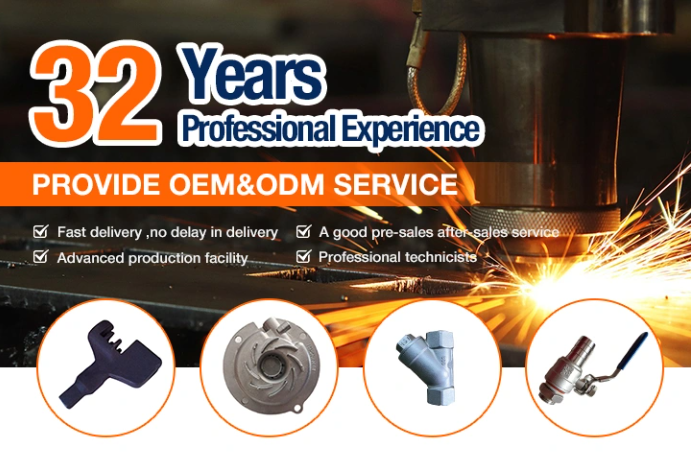
Precision casting parts are widely used in industries that require complex geometries, excellent surface finishes, and high dimensional accuracy. From industrial equipment and automotive components to medical devices and aerospace applications, precision casting provides an efficient solution for producing metal parts that are difficult to manufacture through traditional machining or forging processes.
Among different precision casting methods, lost wax casting (investment casting) is one of the most reliable processes for manufacturing high-precision metal components.
With advanced lost wax casting technology, manufacturers can produce custom precision casting parts with intricate designs, tight tolerances, and excellent surface quality while reducing material waste and secondary machining requirements.
Precision casting parts are metal components manufactured through a casting process that achieves higher accuracy and better surface quality compared with conventional casting methods.
Unlike traditional sand casting, precision casting uses a detailed wax pattern and ceramic shell mold to reproduce the exact shape of the final component.
The lost wax casting process allows manufacturers to create:
Complex internal structures
Thin-wall components
Detailed surface features
Parts with difficult-to-machine geometries
Near-net-shape metal components
This makes precision casting an ideal manufacturing method for OEM customers who need customized metal parts with consistent quality.
Lost wax casting, also known as investment casting, is an advanced metal casting process that uses a wax model to create a ceramic mold.
The basic manufacturing process includes:
A wax model is produced based on the customer’s CAD drawing or 3D model.
The wax pattern has the same shape and dimensions as the final casting part.
Multiple wax patterns can be assembled onto a wax tree to improve production efficiency.
The wax assembly is repeatedly coated with ceramic slurry and fine sand to create a strong ceramic shell.
The ceramic shell is heated to remove the wax, leaving a hollow mold cavity.
This is why the process is called "lost wax casting."
Molten metal is poured into the ceramic mold cavity and solidifies into the final casting.
After removing the ceramic shell, the casting parts undergo:
Cutting
Grinding
Heat treatment
CNC machining
Surface finishing
Quality inspection
The finished products become precision casting parts ready for industrial applications.
One of the biggest advantages of lost wax casting is its ability to manufacture complicated designs.
Compared with machining, investment casting can create:
Curved structures
Deep cavities
Thin sections
Integrated components
without requiring multiple assembly processes.
Lost wax casting provides a smoother surface finish compared with many traditional casting methods.
This reduces the amount of additional finishing required and helps improve the appearance and performance of final components.
Precision casting can achieve tight dimensional control, making it suitable for components that require accurate fitting and reliable performance.
This is especially important for:
Valve components
Pump parts
Machinery components
Automotive parts
Industrial hardware
Lost wax casting supports various metal materials, including:
Stainless steel
Carbon steel
Alloy steel
Tool steel
Aluminum alloy
Copper alloy
Titanium alloy
Material selection can be customized according to strength, corrosion resistance, temperature resistance, and application requirements.
Because precision casting produces near-net-shape components, less raw material is removed compared with machining processes.
This helps reduce:
Material waste
Processing time
Manufacturing costs
A professional lost wax casting manufacturer typically follows a complete production workflow:
Engineers analyze customer drawings, 3D files, tolerances, and application requirements.
Design optimization can help improve:
Casting quality
Production efficiency
Cost control
A production mold is created based on the product design.
The mold determines the accuracy and repeatability of future casting production.
Wax patterns are produced and inspected before shell building.
Multiple ceramic layers are applied to create a durable casting mold.
The selected alloy is melted and poured into the ceramic shell.
Heat treatment improves:
Strength
Hardness
Mechanical performance
Additional processes may include:
CNC machining
Polishing
Grinding
Shot blasting
Passivation
Coating
Precision casting parts can be inspected through:
Dimensional inspection
Material analysis
Hardness testing
Surface inspection
Non-destructive testing
Different applications require different material properties.
Stainless steel investment casting parts provide:
Excellent corrosion resistance
High strength
Good appearance
Long service life
Common applications include:
Food processing equipment
Medical equipment
Marine components
Industrial valves
Carbon steel provides:
High strength
Good wear resistance
Cost efficiency
It is commonly used for:
Machinery components
Structural parts
Heavy-duty equipment
Alloy steel precision castings are suitable for demanding environments requiring:
High temperature resistance
Improved toughness
Superior mechanical performance
Lost wax casting parts are used across many industries.
Applications include:
Engine components
Transmission parts
Brackets
Exhaust components
Precision mechanical parts
Precision castings are commonly used for:
Pump bodies
Valve components
Gear components
Machinery parts
Investment casting is widely used for aerospace components because of its ability to produce lightweight and complex parts.
Precision casting helps manufacture:
Surgical instruments
Medical device components
Stainless steel parts
Stainless steel precision castings are commonly used because they provide:
Hygiene
Corrosion resistance
Easy cleaning
| Item | Lost Wax Casting | CNC Machining |
|---|---|---|
| Complex shapes | Excellent | Limited by tooling |
| Material utilization | Higher efficiency | More material waste |
| Production volume | Suitable for medium and large quantities | Suitable for prototypes and small batches |
| Surface finish | Very good | Excellent |
| Initial tooling cost | Required | Lower |
| Part complexity | High | Limited |
For highly complex metal components, lost wax casting is often more economical than producing the same part through extensive machining.
When selecting a precision casting supplier, consider:
A professional supplier should have complete lost wax casting capabilities, including:
Mold development
Wax pattern production
Casting
Heat treatment
Machining
Inspection
The manufacturer should understand different alloy characteristics and recommend suitable materials according to the application.
Reliable precision casting manufacturers should provide strict quality control throughout the production process.
Important inspection methods include:
Dimensional inspection
Chemical composition testing
Mechanical property testing
Surface inspection
A capable manufacturer should support:
Custom drawings
Prototype production
Small batch orders
Mass production
Customized surface treatment
Lost wax casting is one of the most effective solutions for producing precision metal components with complex designs, excellent surface finishes, and reliable performance.
As a professional precision casting parts manufacturer, we specialize in custom lost wax casting services for customers worldwide.
Our capabilities include:
OEM precision casting parts
Stainless steel investment casting
Carbon steel casting parts
Alloy steel casting components
Custom metal casting solutions
From initial design evaluation to final inspection, we help customers develop high-quality casting components that meet specific industrial requirements.
Whether you need prototypes, small batches, or large-scale production, our lost wax casting expertise provides a reliable manufacturing solution for your precision metal parts.
