Selecting a stainless steel quick disconnect fitting with a 1/2 NPT female thread requires more than matching the nominal thread size. NPT, BSPT, and BSPP connections can appear similar, but differences in thread geometry, pitch, and sealing methods affect whether two components can form a reliable connection.
For SS304 quick disconnect fittings used in fluid transfer and homebrewing systems, identifying the correct mating thread is essential to prevent cross-threading, leakage, and unnecessary fitting replacement.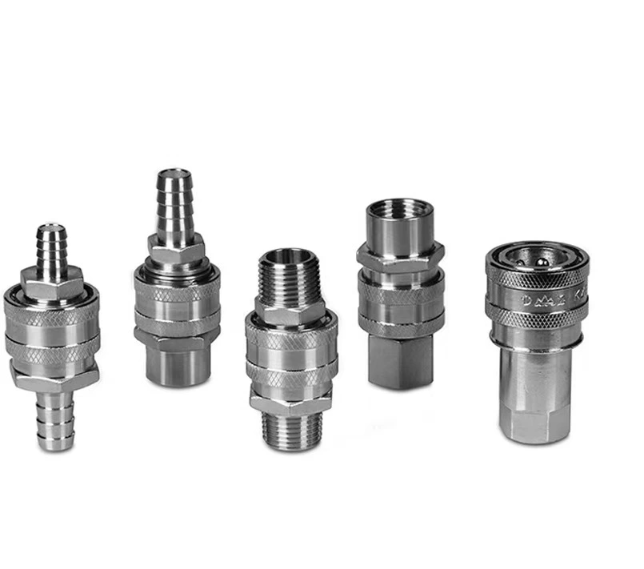
NPT (National Pipe Taper) is an American tapered pipe thread standard defined by ASME B1.20.1. Unlike parallel threads, NPT threads gradually increase in diameter along their length, creating an interference fit when compatible male and female threads are tightened together.
A standard 1/2-14 NPT connection has three important characteristics:
Nominal size: 1/2 inch. This is a nominal pipe-thread designation, not the actual thread diameter.
Thread pitch: 14 threads per inch (TPI).
Thread angle: 60° included angle.
The thread taper is 1:16, measured on the diameter. This means the diameter changes by 1 unit for every 16 units of axial length.
For a female-threaded quick disconnect fitting, the internal thread must be designed to mate with a compatible 1/2-14 NPT male thread.
When inspecting an existing fitting or checking a new component against a technical drawing, use the following identification methods.
Check the Thread Designation
Start with the product marking, technical drawing, or manufacturer's specification. Look for the designation 1/2-14 NPT or 1/2 NPT.
Do not assume that a fitting is NPT simply because it uses an inch-based thread size.
Measure the Thread Pitch
A thread pitch gauge helps determine the number of threads per inch. For a 1/2 NPT thread, the correct pitch is 14 TPI.
This measurement is particularly useful when distinguishing NPT from other pipe thread standards with similar nominal dimensions.
Verify the Thread Profile
NPT threads have a 60° thread angle and a 1:16 taper. Female tapered threads are more difficult to identify through external measurements because the thread geometry is internal.
For accurate verification, use an appropriate NPT thread plug gauge rather than relying exclusively on a caliper.
Confirm the Complete Thread Specification
Thread identification should consider nominal size, pitch, thread form, taper, and sealing arrangement together. A matching nominal size alone does not establish compatibility.
One of the most common connection mistakes is confusing NPT with BSP threads. Although these standards have similar nominal sizes, their thread geometry and sealing requirements are different.
The following comparison highlights the differences relevant to quick disconnect fittings.
1/2 NPT: Tapered thread, 60° profile angle, 14 TPI. Sealing is achieved through the tapered thread engagement with the specified thread sealant.
1/2 BSPT: Tapered thread, 55° profile angle, 14 TPI. It follows a different thread profile and standard from NPT.
1/2 BSPP (G1/2): Parallel thread, 55° profile angle, 14 TPI. Sealing generally relies on a suitable O-ring, gasket, or sealing washer rather than thread interference.
An important point is that 1/2 NPT and 1/2 BSPT both have 14 TPI. Therefore, checking thread pitch alone is insufficient to distinguish them.
Even when a BSP fitting can be partially screwed into an NPT port, this does not mean the connection is mechanically or hydraulically compatible.
For a 1/2 NPT female quick disconnect fitting, specify a matching 1/2-14 NPT male connection or use a properly designed adapter when connecting different thread standards.
Thread compatibility directly affects the assembly and sealing performance of a quick disconnect fitting.
Prevent Cross-Threading and Thread Damage
Mismatched thread profiles can cause uneven engagement, excessive tightening resistance, and damage to the internal threads. This is particularly important for precision-machined SS304 components, where damaged threads can compromise the usability of the fitting.
Maintain Reliable Sealing
NPT connections rely on the interaction between compatible tapered threads and the specified sealing method. Incorrect thread combinations can create leakage paths even when the components appear tightly assembled.
Ensure Consistent Assembly
Using the correct thread specification helps maintain consistent installation across replacement fittings, hose assemblies, and fluid transfer equipment.
For applications involving pressure or temperature variations, verify the complete connection assembly against the manufacturer's pressure and temperature ratings. Thread compatibility alone does not establish the allowable operating conditions.
Before purchasing or specifying SS304 female-threaded quick disconnect fittings, confirm the following technical details:
Thread standard: Confirm that the female port is 1/2-14 NPT, not BSPT or BSPP.
Mating connection: Verify that the male component uses the corresponding NPT thread.
Quick disconnect interface: Confirm the coupling profile, dimensions, and locking mechanism. A matching NPT thread does not guarantee compatibility between different quick disconnect coupling series.
Sealing requirements: Check the specified thread sealant and any additional O-ring or gasket arrangement.
Material: Confirm SS304 material requirements and evaluate whether the actual fluid and cleaning chemicals require a different stainless steel grade.
Operating conditions: Check the required working pressure, temperature range, and fluid compatibility against the manufacturer's specifications.
For custom-machined fittings, providing a complete technical drawing is the most reliable way to communicate these requirements. The drawing should identify the thread standard, thread size, tolerances, mating geometry, and critical dimensions.
Identifying 1/2 NPT female thread compatibility requires checking more than the nominal connection size. Thread pitch, profile angle, taper, and sealing method must all match the intended mating component.
For SS304 stainless steel quick disconnect fittings, clearly specifying the 1/2-14 NPT thread and the required quick disconnect interface helps avoid assembly problems and ensures that the fitting matches the intended fluid transfer system.
Jarzoo Metal provides custom CNC machining services for stainless steel components and precision connectors based on customer drawings and technical requirements. Contact our team to discuss your fitting design, thread specifications, and custom machining requirements.